
Faculty Performance Evaluation (FPE) Support for Reviewers
National Louis University values it’s faculty and their interrelated roles as outlined in the faculty domains: Teaching Excellence, Service, and Thought Leadership. The faculty and the University collectively benefit from the individual faculty member’s achievement and development.
NLU’s faculty evaluations are intended to provide a rational, fair, and systematic process for facilitating professional growth and balancing individual and institutional goals. Further, performance evaluations are expected to form the basis for faculty’s dossiers in the promotion or tenure review process.
Here you will find guidance on using the new performance evaluation form from the perspective of those reviewing FPEs.
General Review Guidelines
- Read through the self-evaluation twice.
- The first time – just read it for understanding.
- The second time – read it with a critical eye. Do you agree with what you’re reading and what you’ve observed? Why or why not?
- Provide evidence of your point of view, whether it’s positive or negative. If you have observed that the person is a strong teacher, describe what you’ve observed over the last year that makes them a strong teacher. If your observations (or other documented observations) lead you to the conclusion that they need to develop their communication skills, for example, what are those observations? Be specific.
- A good review includes actionable feedback. Point them to resources or professional development that can help them. Provide guidelines or steps to improve their performance. Hint: Ask the CTLE or Library for help with PD or readings!
- One of the hardest parts of any review is being straightforward with criticism, especially if you’ve observed performance that you think can be improved. There’s some guidance on this page about having difficult conversations – found in boxes to the right. Highlighting their opportunities for growth is the first step in helping faculty reach their full potential. While this may be critical feedback, delivering it in as supportive of a way as possible will limit defensiveness, increase engagement, and ultimately help your colleague achieve their potential.
- Ask them for feedback on your performance as a supervisor and/or reviewer. It’s helpful if the flow of feedback is bi-directional. It balances the power dynamic, and it makes you human – because you are. We all are. And we all have things to work on. Be open to hearing and acting on their feedback.
For faculty completing FPE or a goal review, the FPE Tool Guidance page will walk them through the FPE tool and offer guidance on how to complete it. They can also review the FPE Support page for info on the process, timelines, and training sessions.
The sessions below provide an opportunity to get additional clarification and ask more direct questions. You can also reach Jon Oelke (joelke@nl.edu) to set up a 1-on-1 support session.
2026 Sessions
|
Faculty FPE Session 3/11 @ Noon (CST) |
Reviewer FPE Session 3/10 @ Noon (CST) |
|---|---|
|
Faculty FPE Session 3/18 @ Noon (CST) |
Reviewer FPE Session 3/19 @ Noon (CST) |
|
Faculty FPE Session 4/22 @ Noon (CST) |
Reviewer FPE Session 4/29 @ Noon (CST) |

The FPE tool is intended to simplify the process and time-to-completion of Faculty Performance Evaluations (FPE) in the following ways:
- Reduce faculty workload:
- Faculty info pre-loaded at the top of the tool
- Courses taught since last review will be auto-loaded
- Previous goals will be auto-loaded
- No more SharePoint—simply respond to the prompts on the screen
- Version control—no need to track, send, or upload word documents
- Easily set goals tied clearly to FPE and promotion criteria
- System-generated prompts let you know where your FPE is in the process and provides a link for easy access
There are four domains in the FPE:
- Teaching Excellence
- Service
- Thought Leadership - This domain reflects Professional Practice and Research, Scholarship, and Inquiry
- Academic Administration - This domain should only be used for faculty with course release for administrative duties.
Here, you can see the general layout of each domain and its criteria. You should be looking to address 1-2 criteria within each domain during your FPE cycle.

How to Address Each Domain - Reviewer's Notes
Guidance for how each section should be used by faculty is below. You will also see suggestions for guiding faculty through the form.
General Info
- Faculty's courses will be auto-populated in the Teaching Excellence Domain.
- Faculty's previous goals for Teaching Excellence, Service, and Academic Administration (if applicable) will be auto-populated.
Reflections
- Faculty will use the upload widget to attach supporting documents. These will open in a new window.
- Faculty are encouraged to reflect on their growth and learning stemming from their accomplishments in addition to any innovative or experimental activities/strategies attempted—even if they were not completely successful.
- We want to highlight and encourage innovative/experimental practices—and what faculty have learned from them.
Goals
- Goal setting should reflect expected achievements and professional growth beyond the day-to-day expectations of faculty
- Faculty should choose a criterion that aligns with their goal.
- Then, faculty should include a brief goal and explain how they plan to reach that goal.
- Remind faculty that they do not need to address each criterion in each domain during every FPE. However, faculty will want to address each criterion in each domain during a promotion or tenure dossier. So, remind faculty to be cognizant of this, as they'll want to shift their goals each year to ensure that they are developing, contributing, and addressing all the criteria for each domain at some point.
- Remind faculty that the content in the "Reflections" section from each FPE will be an excellent starting point for their promotion dossier narrative.
Goal Setting Guidance
Whether completing a full FPE review or just a goal review, please see below for guidance regarding setting goals. As a reminder, faculty who are only setting and reviewing goals, will use the Form for Faculty Goal-setting.
- Outcome-based goals tied to tangible achievements
- Goals that are connected to the Domain Criteria.
- Goals that facilitate development in the Domain (Table)
- Check IDEA scores for Teaching Excellence goals (See Below)
- Review the Teaching Excellence Framework
- Template for Research Agenda (coming soon)
| Adding Specificity | |
|---|---|
| Rather Than... | Seek Specificity: |
| "Teaching my course load" | How will they grow their practice and stretch their competence? |
| "Participate on a senate committee" | What did my committee do and what will I bring to the committee if I’m on it |
| "Continue my research on 'x'" | Do you have a research agenda I can see? That will help contextualize your work. |
Using the Rating Scale
Faculty and their reviewers will have the opportunity to use the rating scale, and any differences between those scores will be fertile ground for meaningful developmental conversations during the 1-on-1 meetings. Please review the ratings and their definitions. The percentages are guidance on how many faculty across the University are likely to receive each rating.
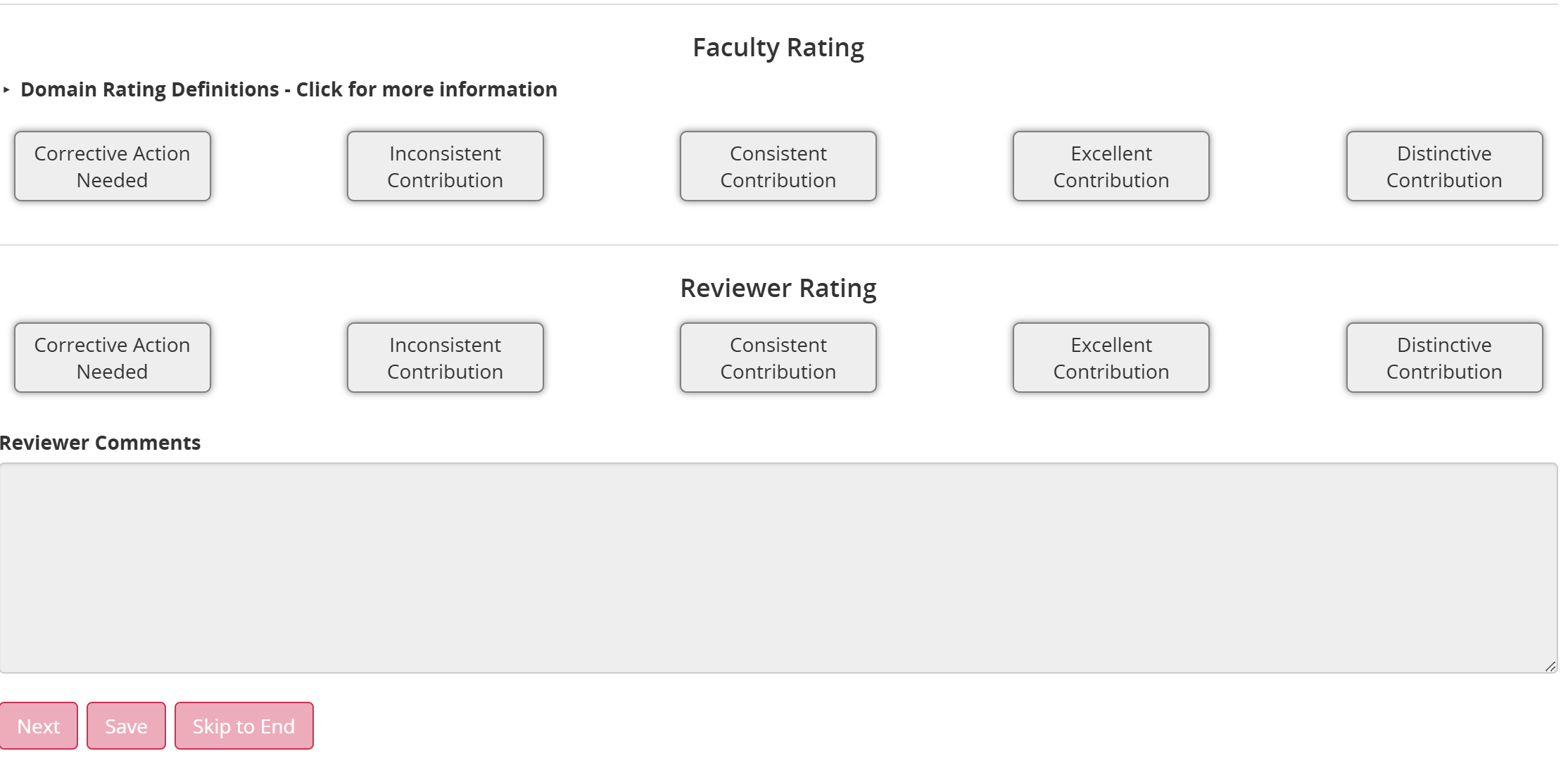
Note: Most faculty will receive a rating of "Consistent Contribution" and that is perfectly acceptable. It will not hurt their chances for faculty awards or promotions. Faculty should be proud to earn a single rating of "Excellent Contribution" or "Distinctive Contribution" during a review cycle.
Faculty should only use the Academic Administration domain if they have load release for administrative duties (chairs, directors, etc.). You may want to touch base with faculty ahead of the review to have a conversation about how work that was previously classified as Service, Professional Practice, or Research, Scholarship, and Inquiry may better align with the Academic Administration Domain.
When discussing the Academic Administration domain, it is recommended to connect this to program review so that chairs think strategically about advancing the program. In essence, the Academic Administration domain should offer faculty an opportunity to provide details about the work they are doing to develop and advance their program and its faculty. For example, you might prompt them to consider:
- What goals do they have for their program?
- What are their plans to achieve those programmatic goals?
- How are they supporting and developing their faculty?
Faculty will use their Thought Leadership Agenda to plan their project or research agenda. Completing this form will help faculty prepare for FPE as most of the form fields are designed to be copy+pasted into the Thought Leadership domain of the FPE.
Please reference the Thought Leadership Guidance page for additional support. This page also includes a link to the Thought Leadership Agenda.
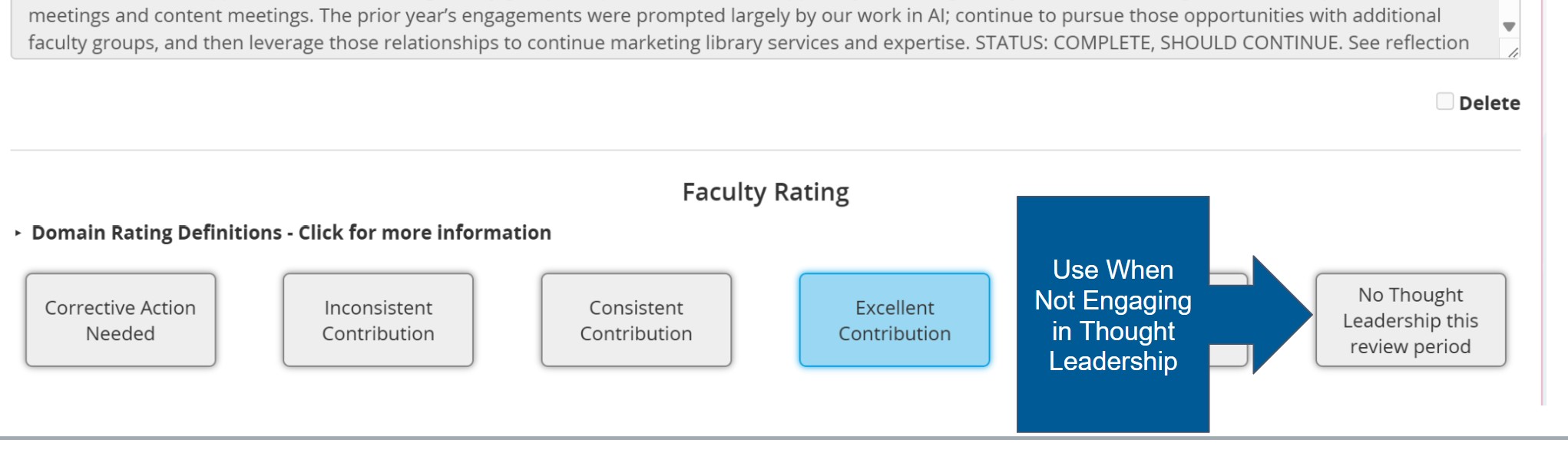
The Thought Leadership or Academic Administration domains will populate for all faculty, regardless of whether or not faculty have load assigned to them. If the faculty does not have load in one of these domains, they can leave the page blank and use the rightmost box to to indicate that the page isn't applicable to them.
Example Activities for Domain Criteria
The Provost Office and Faculty Development Committee collaborated to generate example activities that align with criteria for the Teaching Excellence, Service, Thought Leadership, and Academic Administration domains. These examples are meant to prompt one’s thinking about where various activities might align with the new criteria. These activities are not exhaustive, meaning one may have engaged an activity that’s not represented.
Note: The Academic Administration domain is only for faculty with load release for administrative duties.
- Demonstrate the ability to remain current and connected in one's field or discipline and help students acquire the up-to-date knowledge, skills, and dispositions to acclimate to the discipline's professional practice.
- Teaching strategies in specific courses
- Development of new teaching materials.
- Attending conferences
- Reading books & articles
- Participating in association meetings and professional communities
- Choosing new texts for courses
- Attending workshops/webinars/additional courses taken
- Leading/Participating in PD with colleagues
- Work toward a degree, certificate, or license
- Research, including action research
- Participation in instructional coaching cycle
- Design and facilitate learning experiences and environments to engage learners and personalize the learning to help learners achieve their educational outcomes.
- Program/Course design (new developments and revisions)
- Development of new teaching materials, including videos, worksheets, activities, etc.
- Dissertation/Thesis work with students
- Participation and/or presentation in workshops, seminars, and professional meetings devoted to improving teaching skills
- Peer evaluation, peer observation
- Student feedback on their learning experience (informal email or IDEA survey)
- Create a safe, inclusive, equity-minded, and student-centered learning community where each individual student can succeed.
- Participation and/or presentation in workshops, seminars, and professional meetings devoted to improving teaching skills
- Participation in instructional coaching cycle
- Volunteering at study tables, THRIVE, clubs
- Co-created classroom norms
- Innovative support for students with accommodations
- Student meetings and office hours
- Student feedback on their learning experience (informal email, comments or IDEA survey)
- Employ diverse, creative, or innovative teaching strategies and methods of student support that enhance student learning.
- Development of new teaching materials
- Participation and/or presentation in workshops, seminars, and professional meetings devoted to improving teaching skills
- Action research, responsive teaching strategies, using formative feedback to drive instruction
- Above and beyond supporting students with accommodations
- Dissertation/Thesis work with students
- Student meetings and office hours
- Student feedback on their learning experience (informal email, comments or IDEA survey)
- Contribute and/or take leadership in the University’s and/or College’s shared governance model.
- University, College, or Program-level contributions (Senate, College, Program standing committees, ad hoc committees)
- Contribute to the advancement of the Program, College, and/or University through work on committees, councils, task forces, DEI initiatives, or strategic projects that are outside of shared governance.
- Serve on student recruitment efforts
- Serve on employee recruitment/hiring efforts to fill vacancies
- Interest-based groups
- Starting programs
- Contribute to the advancement of the faculty member’s Program, College, and/or University and its students through non-teaching efforts and projects.
- Service on assessment reports, admission file reviews
- Mentor and assist adjunct faculty teaching courses
- Engage the community as part of your professional activities, and highlight how this engagement impacts the NLU community or the communities NLU serves.
- Outside service such as paper reviews, educational material/course reviews, Grant research and writing, editorial positions, positions in professional organizations
- Volunteer work related to education or our student population
Faculty on the professional practice track should provide a record of accomplishment as a practitioner (Criteria #1). Faculty on the tenure track should provide evidence of the generation, evaluation, and application of knowledge in their field and their dissemination of knowledge both internally and externally (Criteria #2). Criteria guiding a faculty member's performance in this domain are below.
- Demonstrate a significant record of accomplishment as a thought leader within one’s field or discipline.
- Disseminate research, expertise-based knowledge, or creative outputs relative to one’s field in multiple formats to various external audiences.
- Participate, attend or present at a conference
- Published/unpublished papers/cases/instructional materials
- Co-publishing a thesis or dissertation with a student
- Grant written, submitted, or funded
- Articles/manuscripts/book reviews
- Consulting
- Provide thought leadership to local, regional, national, and global communities.
- Serve and take leadership roles in organizations of local, regional, national, and global communities
- Professional Membership
- Officer/Director on Board of professional organization
- Disseminate research, expertise-based knowledge, or creative outputs relative to one’s field in multiple formats to various external audiences.
- Generate, evaluate, and apply findings regarding new and existing knowledge within one’s field.
- Disseminate research, expertise-based knowledge, or creative outputs relative to one’s field in multiple formats to external audiences.
- Participate, attend or present at a conference
- Published/unpublished papers/cases/instructional materials
- Co-publishing a thesis or dissertation with a student
- PD for the NLU community and/or local communities
- New Courses/Curricula
- Provide thought leadership to local, regional, national, and global communities.
- Participate, attend or present at a conference
- Published/unpublished papers/cases/instructional materials
- Grant written, submitted, or funded in collaboration with local, regional, or national partners
- Consulting, Contract research, Policy Analysis
- Action research, new strategies in the classroom
- Participate, attend or present at a conference
- Disseminate research, expertise-based knowledge, or creative outputs relative to one’s field in multiple formats to external audiences.
- Oversight of a college or program unit.
- College/program/assessment reports
- College/program meeting agenda/minutes
- Supervision of faculty and staff within a program or college unit.
- Redacted PFE Feedback forms
- Redacted performance improvement plans
- Redacted course observations
- 1-on-1 check-in summary or report (i.e., how did 1-on-1’s go overall this year? What common challenges were addressed? Provide an example or two of how these sessions contributed to a faculty member’s growth.)
- Meeting minutes where important initiatives are discusses coupled with outcomes/deliverables completed by supervisees from those initiatives
- Management of special projects or initiatives at the program, college, or university level.
- Meeting agenda/minutes
- Progress/end of project reports
